Fiction Choices
1. Don’t Let the Pigeon Drive the Bus!
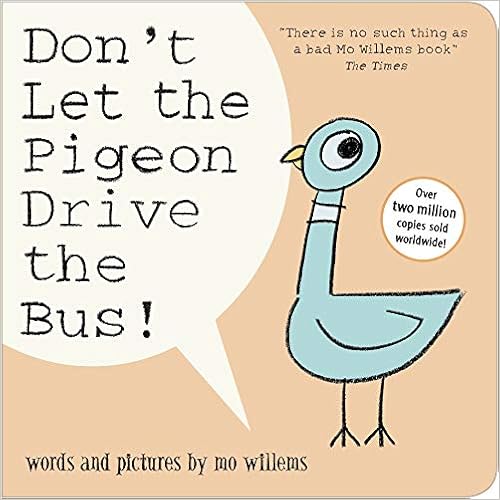
APA citation: Willems, M. (2003). Don’t let the pigeon drive the bus. Walker Books Ltd.
Summary: “The bus driver is leaving for a little while and has one simple request: Don’t let the pigeon drive the bus! It won’t be easy; this bird is pushy. And he can be very persuasive. First, he’ll ask nicely and will promise to be careful. Then he’ll give lists of reasons why he should be driving. Eventually, he’ll just melt down. But will any of his attempts work? This simply (but delightfully) illustrated story puts kids in the driver’s seat, letting them decide the difference between right and wrong.” Retrieved from Scholastic on December 1, 2018 https://www.scholastic.com/teachers/books/don-t-let-the-pigeon-drive-the-bus-by-mo-willems/
Appropriate Age Level: Pre-K, K
Justification: Caldecott Award Winner and a book that one of the students in Mrs.Holland’s class had chose to read, which is the reason I had picked this book. For this book, I chose the standard R.L.K.1- with prompting and support, ask and answer questions about key details in a text. I would use this book to ask the students question about key details, explain to them what key details are, and show them how to answer the questions using the information found in the story. After we practiced a few examples of this throughout the reading, I would have the students draw a picture depicting on of the key details from the story in their journals.
Review: “In a plain palette, with childishly elemental line drawings, Willems has captured the essence of unreasonableness in the very young. The genius of this book is that the very young will actually recognize themselves in it.” Retrieved from School Library Journal, December 1, 2018.
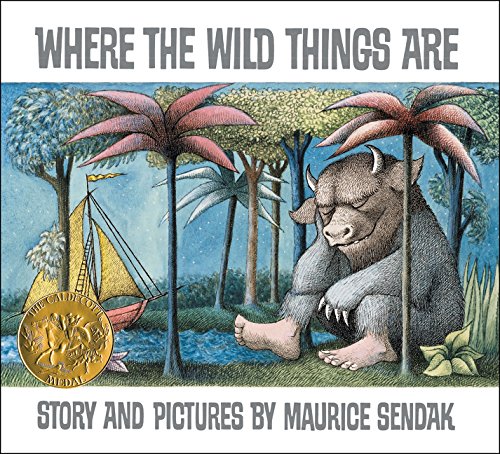
2. Where the Wild Things Are
Sendak, M. (1963). Where the wild things are. Harper and Row.
Summary: “One night Max puts on his wolf suit and makes mischief of one kind and another, so his mother calls him ‘Wild Thing’ and sends him to bed without his supper. That night a forest begins to grow in Max’s room and an ocean rushes by with a boat to take Max to the place where the wild things are. Max tames the wild things and crowns himself as their king, and then the wild rumpus begins. But when Max has sent the monsters to bed, and everything is quiet, he starts to feel lonely and realises it is time to sail home to the place where someone loves him best of all.” Retrieved from Goodreads on December 1, 2018. https://www.goodreads.com/book/show/19543.Where_the_Wild_Things_Are
Age Level: Pre-K, K
Justification: This book is a Caldecott Award winning book which motivated me to use it for an example. This is a book that I love and every time I have read it to kids they absolutely love this book. They love to talk about what happened in the book so this would go great with the standard I have chosen. For this book, I would use the standard R.L.K.2- With prompting and support, retell familiar stories, including key details. After reading the story, I would allow the students to make Wild Things masks and then retell the story to us and even act out a part of the book, I am sure they would love to act out the scene where they throw the party and dance all night. I also would have them draw their favorite part of the book and write a sentence, with support, that tells what is happening in that part of the story.
Review: “The evolution of picture books can be broken down into two time periods: Pre-Wild Things and Post-Wild Things. Sendak’s 1963 book was that instrumental in ushering in the modern age of picture books. While tackling themes of anger and loneliness, Sendak created one of the few picture books that still seems fresh after decades in print. – Travis Jonker” Retrieved from The School Library Journal on December 1, 2018. http://blogs.slj.com/afuse8production/2012/07/02/top-100-picture-books-1-where-the-wild-things-are-by-maurice-sendak/
3. Froggy Gets Dressed
London, J. (1992). Froggy gets dressed. New York, New York: Scholastic, Inc.
Summary: “Rambunctious Froggy hops out into the snow for a winter frolic but is called back by his mother to put on some necessary articles of clothing.” Retrieved from Goodreads on December 1, 2018. https://www.goodreads.com/book/show/815300.Froggy_Gets_Dressed
Age Level: Grade 1
Justification: This is a book that I loved as a child and I read the entire series. Froggy, the main character is always so funny in the stories. I would use this book to help motivate reading since it is such a fun book. The standard that I chose to teach with this book is R.L.K.3- With prompting and support, identify characters, settings, and main events in a story. I would use this book to do a character analysis of Froggy. I would have the students help me describe Froggy using what we know about him from the book and what they can infer about him from the story as well. Then I would have the students color a picture of Froggy from the story and write a sentence explaining one thing about Froggy, with support.
Review: “Abundant onomatopoeia and dialogue betwen a young frog and his mother make this straightforward story a good choice for reading aloud. The rambunctious Froggy has more pressing pursuits on his mind than hibernating through the winter–Snow! Snow! I want to play in the snow!'' Accompanied by kid-pleasing sound effects (zoop! zup! zat!) he excitedly dons cold-weather gear andflop flop flop”s outdoors. His mother, however, quickly points out that he has forgotten a few items; he returns to the house repeatedly for such essential apparel as pants, a shirt and a coat–and his long johns. (One memorable illustration has him tugging a red union suit up to his green chin.) The simplicity of London’s tale is amusingly complemented by Remkiewicz’s ( Greedy anna ; The Last Time I Saw Harris ) typically colorful, playful take on a frisky protagonist. Any youngster who has ever bundled up for wintertime play will surely laugh out loud over this addled amphibian’s constant undressing and dressing. Ages 2-6. (Sept.)” Retrieved from Publisher’s Weelky on December 1, 2018. https://www.publishersweekly.com/978-0-670-84249-0
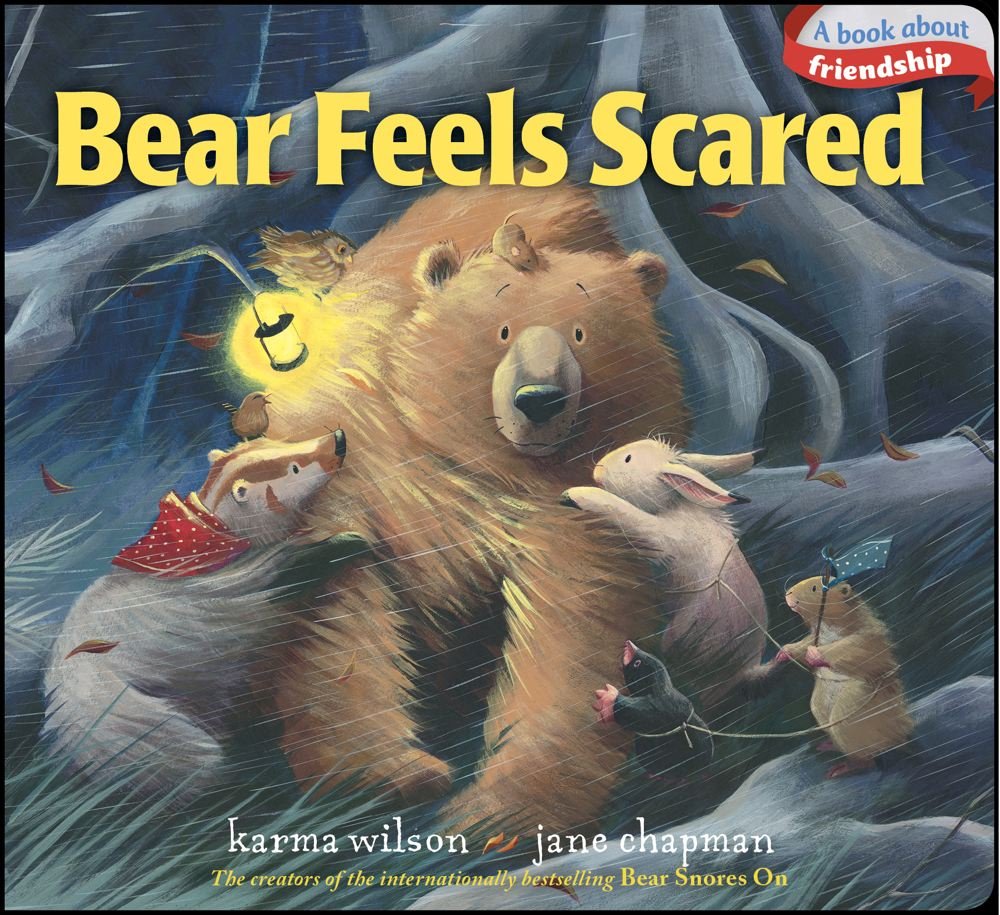
4. Bear Feels Scared
Wilson, K. (2008). Bear feels scared. New York, New York: Scholastic, Inc.
Summary: “Bad weather frightens Bear, but his woodland friends are there to help him in this sweet, reassuring Bear story from bestselling duo Karma Wilson and Jane Chapman!
In the deep, dark woods
by the Strawberry Vale,
a big bear lumbers
down a small, crooked trail…
The sun is setting and it’s getting chilly. When Bear’s friends discover that he is not at home in his lair, they march out into the cold to find their pal. Friends don’t let friends stay lost! Wren, Owl, and Raven take to the skies while Badger, Mole, and Mouse search on the ground. Pretty soon Bear is found, and once he’s back in his cave, he feels quite safe with his friends all around.” Retrieved from Goodreads on December 1, 2018. https://www.goodreads.com/book/show/2730074-bear-feels-scared
Age Level: Pre-k- 5
Justification: This is a book that Kindergarten teacher’s are recommended to use from their Scotts Forsman Teacher Edition’s books. They are given lessons and resources for this book. Bear has a series of books written about him so it is something that the students could be used to during reading time. For this book, I would use the standard, R.L.K.4- Ask and answer questions about unknown words in a text. I would have the students participate in an interactive read aloud and show them how good readers ask and answer questions about unknown words in a story. I would do think-alouds with them stopping on words that they might not know and asking myself “what does this word mean?” I would then show them how to use parts of the text to help them understand words they do not know. Then continue reading and stop on other words they might not know. Then I would have them to draw a picture about a word that they did not know from the story that we discussed in their journals and their picture should demonstrate what the word means.
Review: “Beloved Bear gets another emotional workout, this time a frightening episode in the dark and stormy woods. While Bear is on the trail of a snack, things quickly turn windy, wet and, as Bear gets lost, downright spooky. He cries and trembles, curling up amid the gnarled roots of a huge tree until his ever-faithful band of woodland friends—who have carefully formed a proper search party—come to his aid. Via rhyming text and the repeated refrain “And the bear feels scared,” Wilson and Chapman (Bear Snores On ; Bear Feels Sick ) once again tap into the psychology of preschoolers, exploringa common childhood emotion. Chapman’s acrylics capture the motion of the blowing winds, while Bear’s ultra-expressive eyes and lumbering hulk demonstrate his vulnerability; readers will immediately connect to his experience. Meanwhile, in the cozy fire-lit lair, preparations for Bear’s rescue—replete with lantern and string to tie the searchers to one another—evoke warm feelings about teamwork and support. Ages 3–7. (Aug.)” Retrieved from Publisher’s Weekly on December 1, 2018. https://www.publishersweekly.com/978-0-689-85986-1
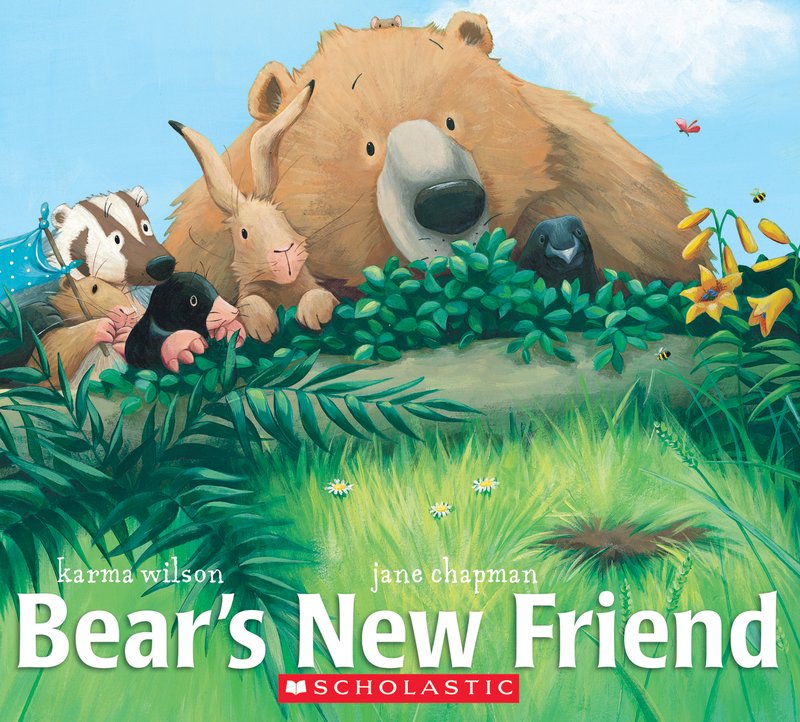
5. Bear’s New Friend
Wilson, K. (2006). Bear’s new friend. New York, New York: Scholastic, Inc.
Summary: “Bear is going to the swimming hole, but first he must find his friends. There’s a clatter in the tree! Is it Mouse? No . . . “Who?” calls Bear. Something quickly scampers by! Is it Hare? No . . . “Who?” calls Bear. Someone seems to be hiding from Bear and his friends. Who is it? WHO? How Bear and his forest friends discover a NEW FRIEND will enchant young readers. Karma Wilson’s playful text and Jane Chapman’s radiant illustrations make Bear’s New Friend a perfect summertime read-aloud companion to the bestselling Bear Snores On.” Retrieved from Goodreads on December 1,2018. https://www.goodreads.com/book/show/62557.Bear_s_New_Friend?from_search=true
Age Level: Pre-K-3rd grade
Justification: This is a book that I love the illustrations that are done throughout it. That is why I chose to do this book with the reading standard, R.L.K.7- With prompting and support, describe the relationship between illustrations and the story in which they appear. I would do another interactive read aloud with this book. I would show the students how they can clearly see what is happening in the book by the illustrations alone. I would read them the text and show how the illustration portrays that part of the text. Then I would have them make a prediction about what is going to happen based upon what they see in the illustration before I read them the text. On an assessment, I would have one picture of something that would happen, then they would have to circle the picture that they think would happen next in the story, between two picture choices.
Review: “It is a hot summer’s day and Bear is eager to go out and play. He leaves his cave and decides to look for his friend Mouse when he hears a strange noise in a tree. Bear calls up to whoever it is thinking that perhaps Mouse is the one who is making the noise. But then mouse arrives on the scene and it is obvious that someone else is up the tree. “Who?” Bear wonders. Can it be Hare? But no, here is Hare and whoever it is has left the tree now and is hiding in a hole in the ground. The whoever it is can’t be Badger, Gopher, Mole, Raven or Wren either. Soon there is quiet a crowd of creatures looking down the hole. Who is in there and why won’t he or she come out? Anyone who is shy will completely sympathize with the mysterious animal who is afraid to show himself to Bear and all of Bear’s good friends. Thankfully for the newcomer he is able to overcome his feelings and soon Bear and company have a new friend to play with at the swimming hole. Children will have a wonderful time trying to guess what the mysterious animal is and will love the expressive and vibrant illustrations that fill every double page spread. Review Written by Marya Jansen-Gruber” Retrieved from Through the Looking Glass Children’s Book Reviews on December 1, 2018. http://lookingglassreview.com/books/bears-new-friend/
Nonfiction-Informational Texts
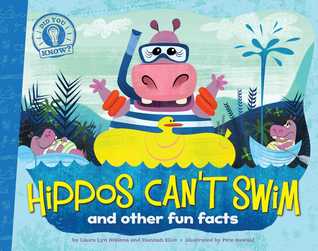
1. Hippos Can’t Swim and other fun facts
DiSiena, L. L. (2014). Hippos can’t swim and other fun facts.New York, New York: Scholastic, Inc.
Summary: “Did you know that hippos can’t swim? This hilarious book is full of fun facts about all sorts of animals, from sleepy ants to jellyfish that glow!
Did you know that a zebra’s stripes are as unique as a human’s fingerprints?
How about that ants take about 250 naps per day?
Or that some jellyfish can glow–and that’s called bioluminescence?
Colorful, humorous illustrations accompany tons of cool facts about animals of all shapes, sizes, speeds, and species in this lively book that makes nonfiction fun!” Retrieved from Goodreads on December 1, 2018. https://www.goodreads.com/book/show/18049049-hippos-can-t-swim-and-other-fun-facts?ac=1&from_search=true
Age Level: K
Justification: This informational text compares many animals on characteristics and abilities. That is why I chose to use this book to teach the standard R.I.K.3- with prompting and support, describe the connection between two individuals, events, ideas, or pieces of information in a text. As I read this book, I would show the students how details in the text to compare two animals. This book has facts on whales, herrons, bats, ants, hippos, rabbits, kangaroos, chipmunks, raccoons, zebras, fireflys, jellyfish, and sea turtles. I would show a few examples of how we can compare the animals using the texts and then I would have the students draw a picture about two animals the book compared and write, with support, a sentence on something they do similarly or differently.
Review: “Smooth segues provide the cement for this high-wattage, if less-than-carefully illustrated, set of animal facts.
Oswald’s cartoon images of popeyed, well-caffeinated creatures crank up the visual energy to frantic levels. Unfortunately, at the outset, they contradict the author’s correct observation that hippos’ noses are placed on the tops of their heads. In another misstep, both illustration and a thought balloon misleadingly suggest that bats can recognize a passing 747 with echolocation (their range is much, much smaller). For the most part, though, DiSiena and Eliot’s revelations are both accurate and just as detailed as they need to be to keep and hold attention. They glide from the hippo’s titular lack of buoyancy (they walk along river bottoms) to the surprising fleetness of sea turtles. From there, it’s on to jellyfish, which don’t actively swim but do flash with bioluminescence—just like fireflies. So it goes, until the parade of facts circles neatly back around to blue whales (“actually the largest animals that have ever lived”) and a closing assurance that “unlike hippos…blue whales sure can SWIM!” Though the authors supply no supportive references or leads to further information, they do tuck in an additional “Fun Fact” about each of the 14 animals at the end. A companion, Chickens Don’t Fly and Other Fun Facts, publishes simultaneously.
The pictures are a weak link, but younger readers and listeners will happily take this quick dive into the sea of random knowledge. Retrieved from Kirkuk Reviews on December 1, 2018. https://www.kirkusreviews.com/book-reviews/laura-lyn-disiena/hippos-cant-swim/
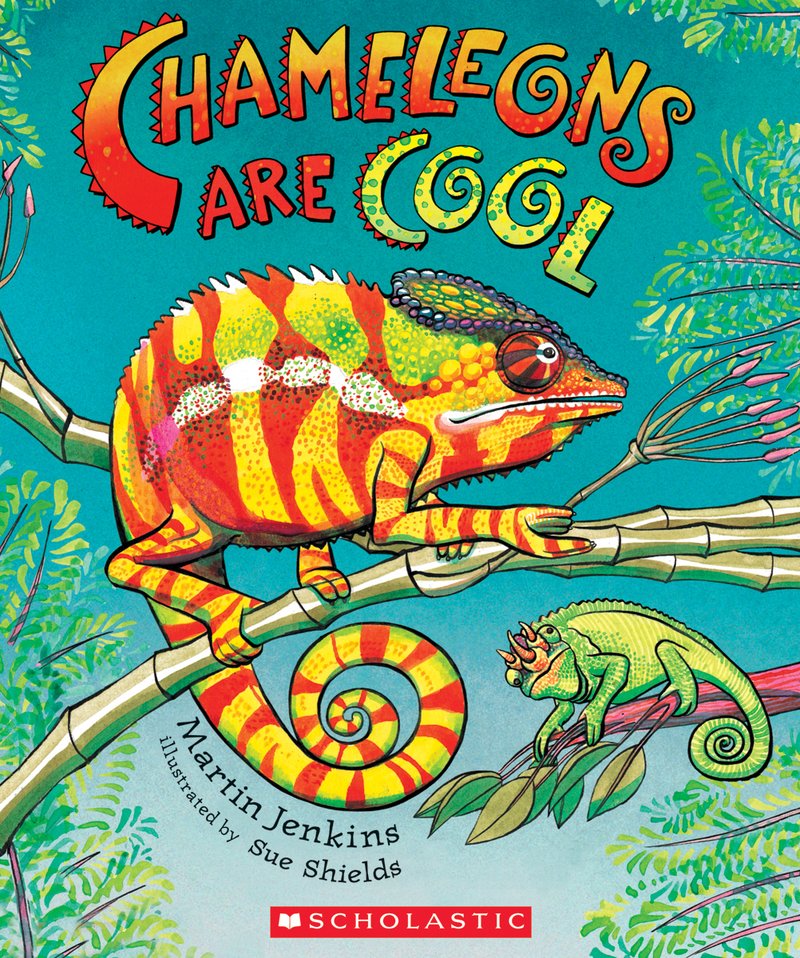
2. Chameleons are Cool
Jenkins, M. (1997). Chameleons are cool. New York, New York: Scholastic, Inc.
Summary: “Who can resist a pocket-sized, bad-tempered, color-changing, swivel-eyed, snail-paced, long-tongued sharpshooter? Kids won’t be able to after reading Martin Jenkins’s amazing portrait of chameleons. With the eye of a scientist and the enthusiasm of a child, Martin Jenkins reveals the very cool facts about chameleons’ life and anatomy. Did you know, for example, that most of a chameleon’s eye is covered in skin, like the rest of its body? It sees through a tiny peephole in the middle! There is so much to know about chameleons, and much of it is right here in this enthusiastic and informative book. Many of the 120 different kinds of this lizard are pictured, as well as facts about and habits of the cool chameleon. Sue Shields’s vivid watercolor close-ups bring a chameleon’s unique features into startling focus.” Retrieved from Scholastic on December 1, 2018. https://www.scholastic.com/teachers/books/chameleons-are-cool-by-martin-jenkins/
Age Level: Pre-k-2nd grade
Justification: I chose this book because many of the students in Mrs.Holland’s class like chameleons and I thought this would be a great way for them to learn more about them. For this text, I would use the standard R.I.K.2- with prompting and support, identify the main topic and retell key details of a story. I would point out parts of the text that help us identify the main topic, in this book the title helps us know what it is about, Chameleons are Cool. The whole book is giving information on chameleons and I would help them to see that. Then after talking about this, I would read them a passage and have them to draw a picture showing what they think the main topic of that passage is as well. Then as a class we could discuss what it is and how we know it is that.
Review: “You have to hand it to Martin Jenkins for creating a natural-science book that can be successfully deployed with preschoolers. The text emphasizes chameleon facts that grab kids’ interest — changing colors, wild rotating eyes, and just plain wild noses, their grumpiness, and their slow approach, followed by a lightning-quick zap of their quarry — while the illustrations are as Technicolor bright as the tropics. One slight drawback is Jenkins’ occasional pandering to readers, starting with “Chameleons are cool.” The inclusion of a young boy in the artwork, in aviator glasses and with his hat on backward, also seems a bit obvious. When this book was read to a library class of 5-year-olds, they immediately began to act grumpy and stick their tongues out at one another. Obviously, chameleons and 5-year-olds share much in common.” Retrieved from Common Sense Media on December 1, 2018. https://www.commonsensemedia.org/book-reviews/chameleons-are-cool
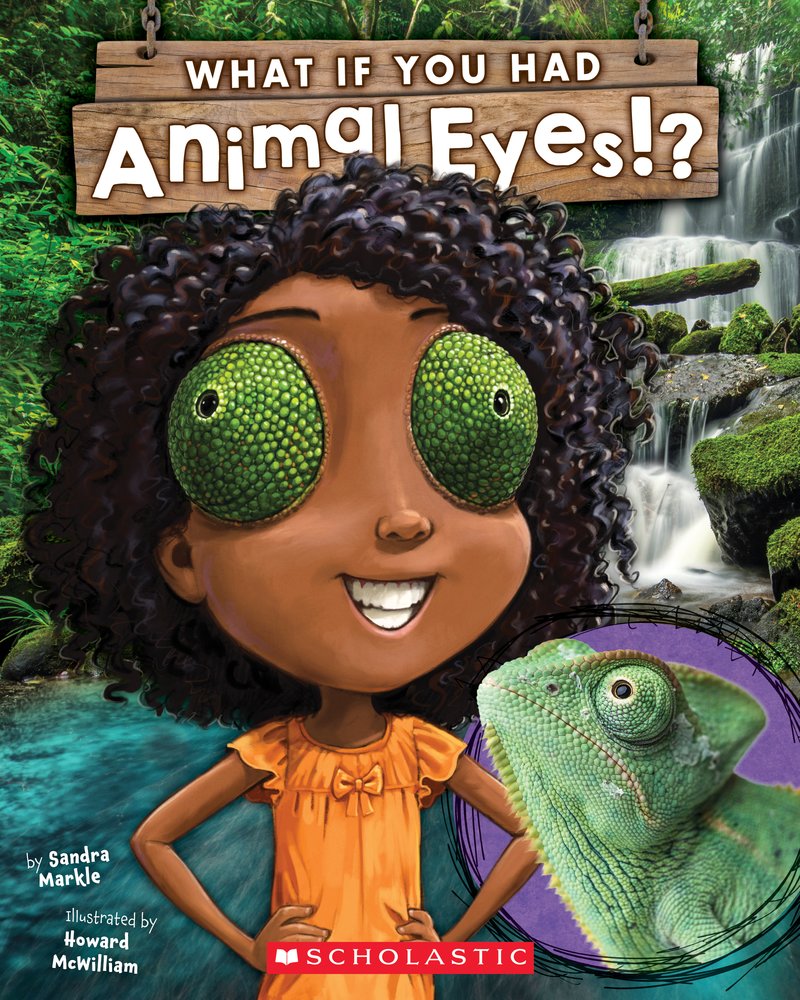
3. What if you had animal eyes?
Markle, S. (2017). What if you had animal eyes? New York, New York: Scholastic, Inc.
Summary: “What if you woke up one morning and your eyes weren’t yours? What If You Had Animal Eyes? explores what would happen if you looked in the mirror and saw an pair of animal eyes instead of your own! From the chameleon’s eyes that can point in different directions, to the colossal squid’s eyes that shine in the dark, discover what it would be like if you had these special eyes, and find out why your eyes are just the right ones for you!” Retrieved from Scholastic on December 1, 2018. https://www.scholastic.com/teachers/books/what-if-you-had-animal-eyes-by-sandra-markle/
Age Level: Pre-k-5th grade
Justification: This book presents a cool way to think about animals in ways that children may not think of right away. We get to think about what it would be to see through the eyes of an animal after learning about different types of animal eyes. The illustrations in this book are phenomenal so I decided to use the standard R.I.K.6- Name the author and illustrator of a text and define the role of each in presenting the ideas or information in a text. While reading the book, we would see a picture of the animal and it’s eyes up close, then the text relates it to what it would be like for a human in a real life example. We could talk about how the text and information we read relates to the images we see in the book. Then I would have them to draw me a picture of an animal from the book and tell how they could use the eyes in real life.
Review: “What if you woke up one morning and your eyes weren’t yours? What If You Had Animal Eyes? — the next imaginative book in the What If You Had series — explores what would happen if you looked in the mirror and saw a pair of animal eyes instead of your own! From the chameleon’s eyes that can point in different directions, to the colossal squid’s eyes that shine in the dark, discover what it would be like if you had these special eyes — and find out why your eyes are just the right ones for you!” Retrieved from Barnes and Noble on December 1st, 2018. https://www.barnesandnoble.com/w/what-if-you-had-animal-eyes-sandra-markle/1125466218#/
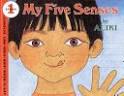
4. My Five Senses
Aliki. (1962). My five senses. Harper Festival.
Summary: “Sight, smell, taste, hearing, and touch—our five senses teach us about our world. Beloved author-illustrator Aliki’s simple, engaging text and colorful artwork show young readers how they use their senses to smell a rose or play with a puppy. This oversize edition—perfect for sharing in a library or classroom—invites young readers to use each of their five senses to explore the world around them. Both text and artwork were expert-reviewed for accuracy. This is a Level 1 Let’s-Read-and-Find-Out, which means the book explores introductory concepts perfect for children in the primary grades and supports the Common Core Learning Standards and Next Generation Science Standards. Let’s-Read-and-Find-Out is the winner of the American Association for the Advancement of Science/Subaru Science Books & Films Prize for Outstanding Science Series.As Children’s Books and Their Creators put it: Aliki “treats complex topics clearly and succinctly while providing lively pictures, with informative details and humorous elements often appearing in ‘balloons.'” Aliki’s books continue to speak to today’s young readers.” Retrieved from Goodreads on December 1, 2018. https://www.goodreads.com/book/show/1963140.My_Five_Senses_Big_Book
Age Level: Pre-k-K
Justification: This is a book that I feel I could have a students practice using their schema to relate the text to things they do with their senses. The standard that I would use is R.I.K.1- with prompting and support, ask and answer questions about key details in a text. While reading the text, the students would see me do think alouds and to show how a good reader questions the details in a text to understand what is happening and why. I would have them help me identify the key details in this text and then we would listen to an informative passage and they would circle the picture that matched a key detail from that passage.
Review: “As Children’s Books and Their Creators put it: Aliki “treats complex topics clearly and succinctly while providing lively pictures, with informative details and humorous elements often appearing in ‘balloons.'” Aliki’s books continue to speak to today’s young readers.” Retrieved from Harper Collins on December 1, 2018. https://www.harpercollins.ca/9780062381927/my-five-senses/

5. Flowers
Gibbons, G. (2018). Flowers.New York, New York: Holiday House.
Summary: “Gail Gibbons has covered seeds, farming, vegetables, and fruits–and now it’s time for flowers! This lush introduction to the basics and life cycle of flowers–including common regional species, flowers’ habitable range, basic flower care and cultivation, and flower anatomy and pollination–is gorgeously illustrated and clearly presented. After reading Flowers, kids will have a new appreciation for the beautiful blossoms around us!” Retrieved from Goodread on December 1, 2018. https://www.goodreads.com/book/show/36701648-flowers?from_search=true
Age Level: Pre-K-2nd grade
Justification: This is a book that I could integrate with science and reading when I am teaching about flowers. The standard that I would use for reading would be R.I.K.9- With prompting and support, identify basic similarities in and differences between two texts on the same topic. I could read this book to them and another book on flowered, like Grow Flowers Grow, a fiction book about flowers. And explain the differences between the two and the similarities. How one just gives general facts about flowers and how they grow and how the other has a story line that mentions how the character learns that a flower needs water, sunlight, and soil to grow. Then I could have the students draw a scene that is similar or different from the books as an assessment or even to circle a picture of the scenes that are similar.
Review: “A very busy informational picture book for preschool and primary grades. There is almost too much information in this 32-page compendium. Following a generic one-line introduction, Gibbons launches into discussions of climate, how and where plants grow (from seeds, from bulbs, and on vines, bushes, and trees), habitats, environment, annuals, perennials. This occupies 10 pages. Another 10 pages explain the parts of a flower as well as pollination and propagation. “How to Grow a Garden” fills six pages, starting with “Spring” and including pages for “Summer” and “Fall” (but no Winter). Finally, Gibbons discusses community gardens, greenhouses, and florists before a concluding page with thumbnail drawings of “Birthday Flowers as well as assorted “Flower Facts”—curiosities that may intrigue readers patient enough to find them. The large, 10-inch-square trim, and the attractive, detailed, and accurate watercolor-and–colored-pencil illustrations outlined in black ink within, will attract picture-book readers, but the cramped and cluttered layout may be off-putting. At the same time, the absence of a table of contents or index limits its utility for older students’ research. Gibbons’ fans may be disappointed by the overreach. Gibbons’ lovely botanical renderings are ill-served by the effort to cover too much for the format.” Retrieved from Kirkus Reviews on December 1, 2018. https://www.kirkusreviews.com/book-reviews/gail-gibbons/flowers/
 LTCY 320- Annotated Bibliography